
The 2027 Challenge Guide
This post contains affiliate links; as an Amazon associate, I earn from qualifying purchases.
Have a question about a prompt on our 2027 Challenge? This 52 Books in 52 Weeks challenge comes with a wide range of prompts, and sometimes, we need a little clarification. So if you find yourself asking questions like, “What does this prompt mean?” or “How can I interpret this prompt in a different way?” you’re in the right spot.
This 2027 Challenge Guide will walk you through each of the fifty-two prompts on this year’s challenge. Below, you’ll find explanations as to what each prompt means, as well as alternative interpretations, ideas, Goodreads lists, and/or tips for completing this challenge.
Important Notes:
- This guide is not an exhaustive list of ideas. Treat it as a tool, but remember, there are always other interpretations and creative ideas for tackling this challenge. After all, one of our main challenge mottos is, “If you think a book fits the prompt, it does!”
- Keep in mind that everyone completes the challenges differently. You may be super strict with your interpretation of the prompts OR you may enjoy getting creative and thinking outside the box. How you choose to complete this challenge is ultimately up to you. YOUR CHALLENGE, YOUR RULES. Have fun with it!
Don’t forget to bookmark this page! We recommend keeping this post close by for when challenge questions arise. This is your go-to spot for all 2027 prompt-related questions. Feel free to direct others here if they have questions, too!

1. Title starts with the letter “Q”
One of the “sub-challenges” we’ve been slowly working on for the past seven years is our title alphabet challenge. This year, we want you to find a title that starts with the letter “Q.” This may be the main title, subtitle, or a series title.
Some books may have alternate titles depending on the region (or language) they’re published in. As long as at least one edition has a title starting with the letter Q, you can read that book using any format, language, or edition.
It’s up to individual participants whether or not they choose to include definite or indefinite articles (The, A, or An) as the first word in the title.
Examples: Queenie by Candice Carty-Williams, Q is for Quarry by Sue Grafton, Quiet: The Power of Introverts in a World that Can’t Stop Talking by Susan Cain, Quicksilver by Callie Hart, Queen of Shadows by Sarah J. Maas
Goodreads List: Title starts with the letter “Q”
2. Audiobook with sound effects
Books matching this prompt should have an audiobook version that includes sound effects.
Sound effects make an audiobook experience more immersive. It may include sounds like music, wind or rain, footsteps, car horns, etc. The sound effects are intended to pull you deeper into the story. It may or may not feature a full cast of characters or a radio play.
As with all of our prompts, this prompt can be completed using any format of reading. Listening to the audiobook version is not required to complete this prompt. As long as the audiobook version includes sound effects, use the format or edition of your choice.
Examples: The Graveyard Book by Neil Gaiman, Project Hail Mary by Andy Weir, Worst Case Scenario by T.J Newman, Daisy Jones and the Six by Taylor Jenkins Reid, Mickey7 by Edward Ashton
Goodreads List: Audiobook with sound effects
3. Author with three names
For this prompt, find an author who publishes under three names. (A famous example of this is the author of Sherlock Holmes, Sir Arthur Conan Doyle.) Choose any book written by an author who publishes under three names.
This may be the author’s legal name or a pen name/pseudonym. It is up to individual readers whether or not they choose to include authors with hyphenated surnames. Similarly, it is the reader’s choice whether to include authors who use initials (example: C.S. Lewis or Sarah J. Maas).
As an alternative interpretation, you may decide to use an author who has published under three separate names or pseudonyms. (Some authors may use different pseudonyms when publishing under different genres.) For example, Nora Roberts writes under her own name, as well as three primary pseudonyms: J.D. Robb, Jill March, and Sarah Hardesty. As always, if you think a book fits the prompt, it does!
Examples: The Complete Sherlock Holmes Collection by Arthur Conan Doyle, The Home Front Sisters by Amy Lynn Green, The Bell Tolls at Traeger Hall by Jaime Jo Wright, Sleep No More by Jayne Anne Krentz, One Hundred Years of Solitude by Gabriel García Márquez, Little House in the Big Woods by Laura Ingalls Wilder, A Killer Motive by Hannah Mary McKinnon
Goodreads List: Author with three names
4. Rags to riches
Rags to riches is an idiom that describes a very dramatic, positive financial change as someone rises from poverty to wealth. For this prompt, we’re looking for a book that features a rags-to-riches element. This may be a dramatic rise in financial status or social standing, and may occur in either fiction or non-fiction.
This narrative arc occurs across genres. It is a popular theme in fairy tales or retellings (such as Cinderella or Aladdin), romance novels (billionaire romance, royalty romance), historical fiction (think Jane Eyre or Oliver Twist), fantasy (a humble character gains power or status to save the Kingdom), etc.
You may choose a classic “rags-to-riches” story in which the plot specifically revolves around an individual, family, or business that overcomes adversity and trials to become extremely successful. Alternatively, it could appear as a secondary storyline where significant financial gains occur for a character, but isn’t the main theme or motivation of the story (for example: The Count of Monte Cristo by Alexandre Dumas).
As a creative twist, you might choose a book about financial literacy to help readers better invest, budget, or manage their finances, etc.
Examples: The Inheritance Games by Jennifer Lynn Barnes, Oprah: A Biography by Kitty Kelley, To Love a Lady by Gabrielle Meyer, Red Queen by Victoria Aveyard, Ready Player One by Ernest Cline, An Offer From a Gentleman by Julia Quinn
Goodreads List: Rags to Riches
5. A book you’ve been putting off
This prompt is for any book that you have personally been putting off. Maybe it’s a book that’s been sitting on your shelf for months (or years), a book that keeps getting bumped for other books on your TBR, or a book you simply haven’t been in the mood for. You might have put it off due to its length, content, genre, author, etc. But now is the time. Your TBR thanks you.
Goodreads List: *There is no Goodreads List for this prompt*
6. Set in a close-knit community
A close-knit community is a group of people or neighbours who are closely connected, helping each other in time of need, supporting one another, and building a sense of belonging and togetherness.
Choose any book that features a close-knit community. This community may play a large or small role in the story. It may be a larger community (like a small village or neighbourhood) or something smaller (like an apartment building or book club). A close community may be a positive or negative thing (for example, a cult). Alongside positive aspects, tight communities may also contain a lot of recurring tension, forced conformity, or unresolved conflicts. Just because they’re close-knit doesn’t mean they don’t have secrets buried deep!
Examples: Mad Mabel by Sally Hepworth, The Thursday Murder Club by Richard Osman, Gilead by Marilynne Robinson, Beartown by Fredrik Backman, The Girls by Emma Cline
Goodreads List: Set in a close-knit community
7. Same series: book one
Prompts 7, 8, and 9 are connected. We’re looking for three books in the same series. The series must have a minimum of three books, but it may have more. (It’s up to participants whether to include prequels, novellas, or 1/2 books.) There are two different ways to tackle these prompts:
- Read books #1, #2, and #3 from the same series. It does not have to be a trilogy, but it may be. This is a great option for readers wanting to start a new series.
- OR, pick any three books from a series. For example, you may choose to read #15, #18, and #28. They must be part of the same series, but they do not need to be in order. This is an option for readers wanting to continue or catch up on a series they’ve already started.
Examples: The Fellowship of the Ring by J.R.R. Tolkien, The Lightning Thief by Rick Riordan, The Girl with the Dragon Tattoo by Stieg Larsson, Crazy Rich Asians by Kevin Kwan, Before I Let Go by Kennedy Ryan
Goodreads List: Same series: book one (Note: Prompts 7, 8, and 9 share a Goodreads list.)
8. Same series: book two
Prompts 7, 8, and 9 are connected.
For these three prompts, we’re looking for three books in the same series. See prompt seven for more details.
Examples: The Two Towers by J.R.R. Tolkien, The Sea of Monsters by Rick Riordan, The Girl Who Played with Fire by Stieg Larsson, China Rich Girlfriend by Kevin Kwan, This Could Be Us by Kennedy Ryan
Goodreads List: Same series: book two (Note: Prompts 7, 8, and 9 share a Goodreads list.)
9. Same series: book three
Prompts 7, 8, and 9 are connected. See prompt seven for more details.
Examples: The Return of the King by J.R.R. Tolkien, The Titan’s Curse by Rick Riordan, The Girl Who Kicked the Hornet’s Nest by Stieg Larsson, Rich People Problems by Kevin Kwan, Can’t Get Enough by Kennedy Ryan
Goodreads List: Same series: book three (Note: Prompts 7, 8, and 9 share a Goodreads list.)
10. Related to the word “Fate”
According to the Oxford English Dictionary, fate is “That which is destined or predetermined to happen to a particular person or thing. Originally (and still often) regarded as ordained by a supernatural force or agency; the destiny or appointed lot of a person or thing.”
The word “fate” is used in a variety of ways. We may use it to describe a person we were “fated to meet romantically,” our ultimate fate (death), a destined course of events, etc. For this prompt, we’re looking for any book somehow related to the word “fate.”
This may relate to the title, plot, character name, how you found the book, etc. It may also be a key phrase, quote, or reference to fate within the book. The book may explore the theme of “fate” or “destiny.” There may be a character who has been fated to be “the chosen one” or characters who are “fated mates.” It may also explore characters or themes of free will opposing fate, etc.
Examples: Macbeth by William Shakespeare, The Giver by Lois Lowry, A Shadow in the Ember by Jennifer L. Armentrout, The Names by Florence Knapp, The Immortalists by Chloe Benjamin, Cloud Atlas by David Mitchell
Goodreads List: Related to the word “fate”
11. First chapter is more than ten pages
For this prompt, choose any book in which the first chapter has more than ten pages.
It’s up to individual readers whether or not they count prologues or introductions as the first chapter.
You can choose to complete this prompt using any format of reading. Different editions may have different page counts. As long as at least one edition fits this prompt, you can read the book using any edition.
Examples: To Kill a Mockingbird by Harper Lee, Six of Crows by Leigh Bardugo, The Story Keeper by Kelly Rimmer, The Mayfair Bookshop by Eliza Knight, 18 Tiny Deaths by Bruce Goldfarb
Goodreads List: First chapter more than ten pages
12. Book is a three-time award winner
For this prompt, we’re looking for books that have received wide literary fame. Choose a book that has won three or more different awards. Awards may be called an “Award,” “Prize,” etc. (Examples of popular book awards include: The Booker Prize, The Pulitzer Prize, The Hugo Awards, The Edgar Award, The Giller Prize, Goodreads Choice Awards, etc.)
The book may have won the awards at any time, and for any edition or format. Awards may be local, national, or international.
For this prompt, we’re specifically looking for books that have won at least three awards. As a creative interpretation, you may include books that have won second or third-place prizes, etc. Alternatively, rather than an official award, they may also have been declared “the best book of the year” by a book club, popular celebrity, bookish organization, local library, etc.
Note that this prompt is for a book that is a three-time award winner, not an author who has won three awards. (The author may have won multiple awards over the course of their writing career, but for this prompt, we’re looking for a specific book with multiple awards.)
Examples: All the Light We Cannot See by Anthony Doerr, Wolf Hall by Hilary Mantel, The Graveyard Book by Neil Gaiman, Bel Canto by Ann Patchett, The Underground Railroad by Colson Whitehead
Goodreads List: Book is a three-time award winner
13. Follows a character from childhood
For this prompt, we’re looking for a book that follows a specific character from childhood through to a later part of their life. This may be until early adulthood (a bildungsroman), a key moment in their later life, or all the way until their death. This may be told progressively or using flashbacks. The character may be a primary or secondary character, but we should get clear scenes from both their younger and later years.
You may also choose a book from a series that starts with a young character in their childhood and follows along as they grow up. (For example: The Anne of Green Gables series.)
This prompt works well with either fiction or non-fiction (an excellent opportunity to try a biography or memoir!)
Examples: The Dutch House by Ann Patchett, The Goldfinch by Donna Tartt, The Heart’s Invisible Furies by John Boyne, Life After Life by Kate Atkinson, East of Eden by John Steinbeck
Goodreads List: Follows a character from childhood
14. 2018: By an author under 30
This year, The 52 Book Club turns ten! As part of the anniversary celebrations, the next ten prompts will celebrate some classic and favourite 52 Book Club prompts. This throwback prompt is from our first-ever 52 Book Club Challenge: The 2018 Challenge.
Books chosen for this prompt can be published any year. They do not need to be from 2018.
For this prompt, we’d like you to choose a book written by an author under the age of 30. The author may be currently under the age of thirty, or may have been under the age of thirty when that specific book was published.
Examples: Frankenstein by Mary Shelley, The Tiger’s Wife by Téa Obreht, The Bone Season by Samantha Shannon, White Teeth by Zadie Smith, Red Rising by Pierce Brown
Goodreads List: Written by an author under 30
15. 2019: Name of a colour in the title
Our second throwback prompt is from our 2019 Challenge and was voted for by our 52 Book Club community! For this prompt, choose any book that includes the name of a colour in the title or subtitle. This may be one of the common basic colours (red, orange, yellow, green, blue, black, purple, pink, grey, white, etc.). Or, it may be a specific shade (plum, indigo, scarlet, merlot, emerald, olive, cornflower, lime, mint, cherry, etc.).
As a creative twist, the colour may also be found within another word. For example, the colour “black” inside the word “blackbird,” or the word “red” inside the word “kindred.”
Books published in other regions or languages may have alternative titles. As long as at least one edition contains a colour in the title, feel free to read that book using any version or edition.
Examples: The Color Purple by Alice Walker, Red, White & Royal Blue by Casey McQuiston, The Priory of the Orange Tree by Samantha Shannon, Green Eggs and Ham by Dr. Seuss, The Blue Castle by L.M. Montgomery
Goodreads List: Name of a colour in the title
16. 2020: Published when you were 20
Our next member voted prompt is a throwback from our 2020 Challenge — a book published when you were twenty years old. For this prompt, choose a book that was published when you were twenty. (For example, our friends born in 2007 will read a book published in 2027. Our friends born in 1961 will read a book published in 1981.)
It’s up to you how strict you choose to be with this prompt. For a very literal interpretation, you might choose a book published specifically during the months you were twenty. For example, if you turned twenty on April 1, 2020, you would pick a book published between April 1, 2020 and March 31, 2021. Or, you might choose a book published any time in 2020 or 2021, because you were twenty at some point during those years.
Not yet twenty? Choose a book published when you were twenty months or two years. You could also pick a book published when a family member turned twenty, a book published twenty years ago or twenty years before you were born, a book set in the future when you will be twenty… etc. Lots of options! Don’t be afraid to get creative!
Alternative creative interpretations:
- Not excited by that year? We give you full permission to lie about your age. There are no prompt police here!
- Rather than the specific year you turned twenty, you might also choose a book published when you were in your twenties (age 20-29).
- Alternative creative interpretations include reading a book published when a friend or family member turned twenty instead. (Bonus points if you buddy read it with them!)
Goodreads List: *There is no Goodreads list for this prompt.*
17. 2021: A dual-timeline
The classic 2021 Challenge prompt that we’re exploring for this throwback is “a dual-timeline.” While this is a repeat from our 2021 Challenge, the books you choose for this prompt do not need to be from 2021.
A dual timeline is a cohesive story that is told across two different timelines. It may alternate between past and present, or between two different historical periods – usually with alternating chapters. These stories are linked, working together in tandem, and converging in some way at the end. While many dual timelines are historical fiction, they are found across genres.
Although it is a “dual” timeline, the story may also contain more than two timelines.
Examples: The Alice Network by Kate Quinn, The Sundown Motel by Simone St. James, Keeper of Lost Children by Sadeqa Johnson, The Seven Husbands of Evelyn Hugo by Taylor Jenkins Reid, Every Summer After by Carley Fortune
Goodreads List: A dual timeline
18. 2022: A non-fiction bestseller
Choose any non-fiction bestseller. This is a throwback from our 2022 Challenge! While this is a repeat of a classic 52 Book Club prompt, the books you choose for this prompt do not have to be from 2022. They can be published any time.
What is non-fiction? Non-fiction is a book that presents information about real events, history, facts, etc. It should be based on fact, expertise, and research into a specific topic, rather than the author’s imagination. There are many different genres of non-fiction, including history, biography, self-help, cooking, science, travel, true crime, business, etc.
For this prompt, we’re looking for a non-fiction bestseller. Bestsellers are books that have sold large quantities of copies, usually in a short period of time. They are popular reads that may appear on a “Bestseller List.” They may be a bestseller globally or for a specific country or region. The book may have started as an instant bestseller or become a bestseller over the years.
Examples: Atomic Habits by James Clear, This is Me by Hayden Panettiere, The Glass Castle by Jeanette Walls, Shoe Dog by Phil Knight, London Falling by Patrick Radden Keefe
Goodreads Lists: A non-fiction bestseller
19. 2023: A city or country name in the title
For this throwback prompt from our 2023 Challenge, we are specifically looking for books with a city or country name in the title. This could be either a real-world city or country, or a fictional one. It may also be an ancient city or country that no longer exists. The city or country name may also be found in the subtitle or series title.
While this prompt is from our 2023 Challenge, you do not need to pick books published in 2023.
Examples: The Paris Apartment by Lucy Foley, The Berlin Girl by Mandy Robotham, From Russia With Love by Ian Fleming, Brooklyn by Colm Tóibín, London Falling by Patrick Radden Keefe
Goodreads List: A city or country in the title
20. 2024: At least four different POV
For this 2024 Challenge throwback, pick a book that includes at least four different points of view. This prompt originally appeared on our 2024 challenge, but for this second appearance, feel free to read a book published at any time.
Books that alternate POV (points of view) are told through the perspective of multiple characters. This helps you to better understand each character’s motivations, thoughts, and feelings. Sometimes books with multiple POV can feel confusing, but when they’re done well, they can also really enhance the story.
What this looks like will vary from book to book. Some novels may separate different points of view by chapter. (Example: One chapter from character A’s perspective, the next from character B, then C, and so on…) Other books may have multiple perspectives within the same chapter. The book may prominently feature the perspective of one character and only be sporadically broken up by other perspectives, or it may divide points of view evenly. You may have characters from different time periods, or they may all be within the same setting. The different POV may or may not be human.
As a creative interpretation, you may choose a series that is told from four different main character perspectives.
Examples: Game of Thrones by George R. R. Martin, House Rules by Jodi Picoult, Someday I’ll Find You by C.C. Humphreys, The Last Party by Clare Mackintosh, Six of Crows by Leigh Bardugo
Goodreads List: At least four different POV
21. 2025: Title is ten letters or fewer
Our 2025 Challenge throwback was our final member voted prompt for this year. The winning prompt was, “Title is ten letters or fewer.” (Note, we’ve tweaked the wording of the original prompt slightly from “Title is ten letters or less” to “Title is ten letters or fewer.” Thank you to everyone who pointed out this original grammatical error on the 2025 Challenge.)
For this prompt, choose a title that is ten letters or fewer. The title can be more than one word, as long as the total number of letters in the title is ten or fewer. Whether or not you choose to include subtitles as part of the title length is up to you.
Examples: Widowland by C.J. Carey, The Women by Kristin Hannah, Finding Me by Viola Davis, Happy Place by Emily Henry, Mad Honey by Jodi Picoult, Yellowface by R.F. Kuang
Goodreads list: Title is ten letters or less
22. 2026: Spans a decade or more
What better throwback prompt for our tenth anniversary challenge than a prompt that, “Spans a decade or more.” This was originally featured on our 2026 Challenge but as with all these throwback prompts, books chosen for this prompt do not need to have been published in 2026.
For this prompt, we’re looking for books that span a decade or more. (A decade is a period of ten years.)
This may be a book that follows the life of a single character, individual, or family (either fiction or non-fiction) or a book that flashes forward or backward in time. It may or may not be a dual-timeline. The time period covered within the book should be at least ten years.
Examples: The Invisible Life of Addie La Rue by V.E Schwab, Homegoing by Yaa Gyasi, The Time Traveler’s Wife by Audrey Niffenegger, Sea of Tranquility by Emily St. John Mandel, Life After Life by Kate Atkinson
Goodreads List: Spans a decade or more
23. Any previous 52 Book Club prompt
For our final “throwback prompt” we’re inviting you to choose any previous 52 Book Club prompt to complete! This can be from any of our main 52 Books in 52 Weeks Challenges, our mini-challenges, summer challenges, or our bonus challenges like The Agatha Christie Challenge, Sidequest: High Seas, or our Mystery Challenge.
By the end of 2026, we’ll have released 976 prompts. Choose any prompt that you would like. You may also choose to redo a 2027 Challenge prompt or any of the 2027 Mini-Challenge prompts, if desired.
- You can find all our 52 Books in 52 Weeks Challenges here.
- All our past Mini-Challenges are located here.
- Sidequest: High Seas is located here.
- The Mystery Genre Challenge is here.
- Our Agatha Christie Challenge is located here.
- Beach Reads Summer Challenge is here.
- Our Connections Challenge is here.
Goodreads List: There is no Goodreads list for this prompt
24. Read by a narrator in Audible’s Hall of Fame
There are currently over twenty narrators in the Audible Narrator Hall of Fame. From Julia Whelan (Educated, Gone Girl) to Ray Porter (Project Hail Mary) or Bahni Turpin (The Hate U Give, The Underground Railroad) these narrators span a wide range and body of work.
You can check out the Audible Narrator Hall of Fame list here: https://www.audible.com/blog/narrator-hall-of-fame
As long as a version of the audiobook has been narrated by one of these Hall of Fame Narrators, you can read the book using any format or edition of that book (audio, ebook, or physical).
Examples: All the Colours of the Dark by Chris Whitaker, Beneath a Scarlet Sky by Mark Sullivan, The Wedding Date by Jasmine Guillory, Unbroken by Laura Hillenbrand, Fourth Wing by Rebecca Yarros
Goodreads List: Read by a narrator in Audible’s Hall of Fame
25. Unrelated books with opposite titles (book 1)
Prompts 25 and 26 are connected. For these prompts, we’re looking for two unrelated books that have opposite titles. (Opposite means different, contrary, or far apart.) The title for the book you choose for prompt 25 should be opposite in some way to the title for prompt 26. This is solely related to the title. Books do not have to be opposite in plot, genre, cover, etc.
This may be an exact opposite, for example, books with one-word titles, “Night” and “Day,” or it may be a looser interpretation. As long as the two book titles somehow convey opposites, they fit this prompt.
- Example one: “The Downstairs Girl” by Stacey Lee and “The Wife Upstairs” by Rachel Hawkins
- Example two: “Night” by Elie Wiesel and “Day” by Michael Cunningham
- Example three: “Out of the Blue” by Jason June and “Into the Blue” by Emma Brodie
The books should also be unrelated. This means that they’re not part of the same series, share characters, or written by the same author.
Examples: The Storm by Rachel Hawkins and The Sea of Tranquility by Emily St. John Mandel, The Push by Ashley Audrain and Pull by Brennan Spiegel, Last to Die by Tess Gerritsen and 1st to Die by James Patterson, Nemesis by Agatha Christie and My Friends by Fredrik Backman
Goodreads List: Unrelated books with opposite titles (Prompts 25 and 26 share a Goodreads list)
26. Unrelated books with opposite titles (book 2)
For prompt 26, pick a book with an opposite title to your choice for prompt 25. These should be unrelated, opposite titles. (Not from the same series or author.) See examples of opposite titles above.
Goodreads List: Unrelated books with opposite titles (Prompts 25 and 26 share a Goodreads list)
27. A purple cover
Pick a book with a purple cover. This may be any shade of purple. There may be other colours on the cover, but it should have predominently purple vibes. It may or may not have a purple spine.
Keep in mind that covers may vary by edition or region. As long as at least one edition has a purple cover, feel free to read that book using any edition or format.
Examples: An Impossible Imposter by Deanna Raybourn, Fix Her Up by Tessa Bailey, Sunrise on the Reaping by Suzanne Collins, Assistant to the Villain by Hannah Nicole Maehrer, White Smoke by Tiffany D. Jackson
Goodreads List: A purple cover
28. Divided into parts
Some books are divided into large chunks called parts (or acts.) These sections may reflect different times, themes, settings, or shifts in the narrative. Books usually indicate the start of a new section with a specific title page stating, “Part I,” “Part II,” etc.
While these sections are usually called “Parts” or “Acts,” they may also be labelled as something unique to the story. For example, in The Last Garden in England, the book is broken into four parts that are labelled as the seasons, “Winter,” “Spring,” “Summer,” and “Autumn.”
A book may be divided into two or more parts. These parts usually contain a group of chapters within them.
In some instances, the book may have originally been published in these smaller parts before being grouped together into one larger book. (For example: Little Women.)
Examples: The Barman of the Ritz by Philippe Collin, Little Women by Louisa May Alcott, The Way of Kings by Brandon Sanderson, Where the Crawdads Sing by Delia Owens, The Last Garden in England by Julia Kelly
Goodreads list: Divided into parts
29. Has a tenth anniversary edition
Choose a book that has a tenth anniversary edition (a special edition released to celebrate the book’s tenth year since being published). Tenth anniversary editions may contain bonus content, chapters, a note from the author, special designs, sprayed edges, etc.
You do not have to read the tenth anniversary edition. As long as a tenth anniversary edition exists, you can choose to read that book using any format or edition.
Examples: The Nightingale by Kristin Hannah, Divergent by Veronica Roth, Year of Yes by Shonda Rhimes, Coat of Many Colors by Dolly Parton, Fangirl by Rainbow Rowell
Goodreads List: Has a tenth anniversary edition
30. Leaves you questioning
Books matching this prompt will “leave you questioning.” There are a variety of interpretations for this prompt. Feel free to get creative! Here are a few examples:
- An unresolved ending or plot point (intentional or unintentional by the author)
- A cliffhanger
- Makes you question life: Challenges your views on reality, morality, history, etc.
- About a controversial figure or event
- A philosophical read
- A book that shows you the world from a different perspective
- A puzzle book
- A book that makes you question the reality in which the characters live
- Any thought provoking read fiction or non-fiction
Examples: The Giver by Lois Lowry, Tender Is the Flesh by Agustina Bazterrica, Never Let Me Go by Kazuo Ishiguro, The Handmaid’s Tale by Margaret Atwood, Piranesi by Susanna Clarke, Puzzles & Perils by Laura Jayne Ayres
Goodreads Lists: Leaves you questioning
31. An underdog story
An underdog is an individual or team who is expected to lose. They’re considered the “least likely to win.” Underdogs can appear within a variety of contexts: a sports team, a competition, a political race, a small-town lawyer taking on a big corporation, etc.
For this prompt, we’re looking for a fiction or non-fiction read featuring an underdog story.
Underdog stories usually feature the character’s determination, struggle, and grit to succeed, ultimately culminating in their unexpected triumph against the odds. This should be a main element or theme of the book. The ultimate “success” of an underdog may look different than initially expected. (For example: The team didn’t win their grand championship, but they won the hearts of the fans, etc.)
Examples: The Hunger Games by Suzanne Collins, A Prayer for Owen Meany by John Irving, The Boys in the Boat by Daniel James Brown, The Rainmaker by John Grisham, Fourth Wing by Rebecca Yarros
Goodreads List: An underdog story
32. Same publisher as prompt ten
Choose a book released by the same publisher you used for prompt ten. The books do not need to be related or part of the same series, simply published by the same publisher. They can be published any year.
Publishing houses usually contain numerous imprints or divisions. It is up to individual readers whether they decide to use the same specific imprint, or the larger publishing house. Editions may have different publishers in different regions. As long as at least one edition is published by the same publisher you used for prompt ten, feel free to complete this prompt using any format or edition.
It will be easier to complete prompt ten before completing this prompt; however, you’re welcome to tackle this challenge in any order.
Goodreads List: *There is no Goodreads list for this prompt*
33. Eureka!
Eureka is a word “used to express triumph on a discovery.” (Merriam-Webster.) Books fitting this prompt will somehow relate to the word, “Eureka!” Some examples of ways to interpret this prompt include:
- An experience you have / feel while reading this book
- A mystery you solve before the final reveal
- A book that answers a question you’ve been pondering
- A big reveal that suddenly makes the book or series make sense
- A book that shifts your perspective on the world around you
- Something that sparks an idea within yourself
- A book on or mentioning Archimedes (Greek mathematician and inventor to whom the phrase “Eureka!” is famously attributed).
- A character who has a “Eureaka” moment
- A book about inventions or scientific discoveries
- Dialogue in the book exclaiming, “Eureka!”
Eureka may relate to the title, subtitle, blurb on the back of the book, character, author quote, a scene or moment within the book, a feeling you get while reading, a line of dialogue, etc. There are many ways to interpret this prompt. Don’t be afraid to think outside the box and have fun with it!
Examples: Eureka by Edgar Allan Poe, Project Hail Mary by Andy Weir, Brilliant Blunders: From Darwin to Einstein – Colossal Mistakes by Great Scientists That Changed Our Understanding of Life and the Universe by Mario Livio, An Abundance of Katherines by John Green, Half Broke Horses by Jeannette Walls, Mistborn Trilogy by Brandon Sanderson
Goodreads List: Eureka!
34. Title is in first person
First person is a point of view. We use first person when we’re talking about ourselves. For example, “My friend and I have been enjoying our latest buddy read!” For this prompt, we’re looking for a title that is in first person.
First person pronouns include: I, Me, My, Mine, Myself, We, Our, Us, Ourselves. Any book title or subtitle containing one or more of these words will fit this prompt.
As long as the title is in first person, the book itself can use any narrative type. Books published in various regions may have different titles. As long as at least one edition contains a title in first person, feel free to read that book using any edition or format.
Examples: The Summer I Turned Pretty by Jenny Han, Our Perfect Storm by Carley Fortune, My Husband’s Wife by Alice Feeney, I Know Why the Caged Bird Sings by Maya Angelou, My Dark Vanessa by Kate Elizabeth Russell
Goodreads List: Title is in first person
35. Character is on vacation
Pick a book with a character who is on vacation. A vacation is a temporary time off work or school. It may be a trip to another location such as a beach, a ski lodge, a backpacking trip, etc, or it could be a staycation. (In some countries, a vacation may be referred to as a “holiday.”)
This character on vacation may be a primary or a secondary character. The book’s plot may revolve around the vacation or not.
As alternative interpretations, some people may refer to retirement or being laid off from a job as a “permanent vacation.”
Examples: People We Meet on Vacation by Emily Henry, A Caribbean Mystery by Agatha Christie, One Italian Summer by Rebecca Serle, Nine Perfect Strangers by Liane Moriarty, The Family Holiday by Shalini Boland
Goodreads List: Character is on vacation
36. A political thriller
Political thrillers are thrillers set amidst a political backdrop. Political elements compose a major part of the plot and may feature an election, corrupt government, global political crisis, conspiracy, terrorism, espionage, power struggle, etc. The genre is a blend of politics and suspense.
As a creative interpretation, you might instead choose a political non-fiction book that reads like a thriller (exciting, fast-paced, mind-blowing, conspiracy-related, etc.)
Examples: Absolute Power by David Baldacci, The President is Missing by James Patterson and Bill Clinton, Deep Fake by Ward Larsen, The Manchurian Candidate by Richard Condon, The Last Mandarin by Louise Penny and Mellissa Fung
Goodreads List: A political thriller
37. Has an index
In publishing, an index is an alphabetical list of important terms, topics, names, and places discussed in a book, along with the pages where they are mentioned. The purpose of the index is to provide a quick and easy way for readers to locate specific information in a book. (Reedsy Blog)
Indexes are commonly found within non-fiction but may be found within other genres. (For example: The Lord of the Rings.) They’re usually found within the final few pages of a book but you may include books with digital indexes.
Looking for an alternative interpretation? The word index can also refer to a financial term that reflects the price of a collection of stocks or bonds. We also refer to the first finger on our hand as our “index finger” (pointer finger.) Either of these definitions may somehow tie in or relate to the book. You may also have a character within the story who indexes something or creates an alphabetical list of something. Get creative!
Examples: Atomic Habits by James Clear, Courage and Grit: The Legacy of Canada’s Bomb Girls by Barbara Dickson, 18 Tiny Deaths: The Untold Story of the Woman who Invented Modern Forensics by Bruce Goldfarb, V is for Venom: Agatha Christie’s Chemicals of Death by Kathryn Harkup, The Diana Chronicles by Tina Brown
Goodreads List: Has an index
38. Low fantasy
Back in 2023, we featured “high fantasy” on our annual challenge, stirring up all sorts of delicious reader debates. This time, we want you to tackle “low fantasy.” (Cue the opinions on portal fantasy or magical realism, and if they overlap with low fantasy!)
What is low fantasy? Low fantasy is a subgenre of fantasy. This is where you have magical or supernatural elements, but the story is set on Earth (or another realistic world). Non-rational things are occurring in a world where they’re not supposed to. Low fantasy may take place in a recognizable contemporary setting, a historical era, or an alternate reality. This is in contrast to “high fantasy,” which takes place in an entirely invented secondary world.
Keep in mind that genres are never perfectly defined. Some books may blend high and low fantasy elements.
As an alternative interpretation, you may recognize “low fantasy” as a fantasy novel which is light on fantasy elements. Or stick a fantasy novel on the bottom shelf of your bookshelf and call it “low.” (Just don’t add that one to the Goodreads list. 😉) Creative workarounds are always welcome.
Examples: Charlie and the Chocolate Factory by Roald Dahl, The Time Traveler’s Wife by Audrey Niffenegger, Babel by R.F Kuang, The Lightning Thief by Rick Riordan, Jonathan Strange and Mr Norrell by Susanna Clark
Goodreads List: Low fantasy
39. A bird on the cover
Choose a book with a bird on the cover. This may be:
- A bird included in the cover design. (lt may be a key element of the design, or a small detail in the distance.)
- A specific bird name in the title
- The word “bird” in the title
- A bird name as part of the author’s name (Example: An author whose first name is Robin, Wren, Jay, etc. Or whose last name is a bird like “Hawks,” “Crow,” etc.)
These may be real or fictional types of birds.
As long as one edition has a bird on the cover, you may read that book using any format or edition. It may be found on any part of the front or back cover, or the spine.
Examples: Mockingjay by Suzanne Collins, To Kill a Mockingbird by Harper Lee, I Know Why the Caged Bird Sings by Maya Angelou, The Complete Stories and Poems by Edgar Allan Poe, The Goldfinch by Donna Tartt
Goodreads List: A bird on the cover
40. Set in a fictional country
Pick a book set in a fictional country. A fictional country is a country created for the story that does not exist in real life. This may be a fictional country set on Earth (hello, Genovia), a fictional country in an alternate reality, or a fictional country set in another world.
While you may naturally think of fantasy for this prompt, fictional countries can be found across genres. The book may be fully or partially set within this fictional location.
Examples: The Princess Bride by William Goldman, The Hunger Games by Suzanne Collins, Fourth Wing by Rebecca Yarros, The Lion, The Witch, and the Wardrobe by C.S Lewis, The Princess Diaries by Meg Cabot, The Man in the High Castle by Philip K. Dick
Goodreads List: Set in a fictional country
41. ISBN ends in -6
An ISBN (International Standard Book Number) is a 13-digit number that uniquely identifies each specific edition of a book. (Before 2007, ISBNs were 10 digits.) A hardcover, paperback, and e-copy of the same title will all have unique ISBNs.
For this prompt, we’re looking for a book with an ISBN ending in “6.”
A book’s ISBN number is on the back cover by the barcode, or inside the copyright page at the front of the book. You can also find ISBN numbers under the book details section on Goodreads, Amazon, or StoryGraph.
We love to keep things easily accessible for everyone at The 52 Book Club. As long as at least one edition or format ends in the number six, you may read that book using any format or edition.
Examples: The Stone Cutter by Camilla Lackberg, Why Didn’t They Ask Evans by Agatha Christie, The Forgotten Garden by Kate Morton, I am David by Anne Holm, The Lincoln Lawyer by Michael Connelly
Goodreads List: ISBN ends in -6
42. Includes a party
For this prompt, choose any book that includes a party. The party may play a key role in the overall plot or it may be a single scene.
Parties are social gatherings where people celebrate an event or socialize for entertainment. Examples of types of parties may include: birthday parties, dinner parties, house parties, costume parties, a masked ball, a cocktail party, frat party, etc.
You may also choose to interpret the word party in another way, such as a political party, a hunting party, wedding party, the Donner party, etc.
The word party may or may not be a part of the title or featured as part of the cover design.
Examples: The Fellowship of the Ring by J.R.R Tolkien, The Great Gatsby by F. Scott Fitzgerald, The Seven Husbands of Evelyn Hugo by Taylor Jenkins Reid, The Party Crasher by Sophie Kinsella, Crazy Rich Asian by Kevin Kwan
Goodreads List: Includes a party
43. Copy has a misspelling or grammatical error
If you look close enough, you’ll likely find a misspelling or grammatical error in at least one of your reads this year. Use that book to fill this prompt! (You may not be able to plan this prompt in advance, and that’s okay!)
Throughout history, there have been some humorous publishing errors. For example, The Wicked Bible of 1631 accidentally left out the word “not” in the seventh commandment. (For giggles, check out this list of funny typos: https://www.rd.com/list/funny-typos-in-literature/)
You may use a finished copy, advance reader copy, or even a friend’s unpublished manuscript for this prompt! As long as at least one published or accessible edition contains a misspelling or grammatical error, feel free to read that book using any format.
As an alternative interpretation, you might choose a title in which a word has been deliberately misspelled, such as Stephen King’s Pet Sematary or A Purrfect Alibi by Leighann Dobbs. This could also feature misspellings or improper grammar within the narrative intentionally used to capture a character’s distinct speech patterns.
Goodreads List: Copy has a misspelling or grammatical error
44. Image of a person on the spine
The spine is the portion of the book that usually faces outwards on a bookshelf. It is the edge of the book where the pages are bound together.
For this prompt, pick a book with a person on the spine. The image may be illustrative, realistic, abstract, large, or small. It may be part of the design or the publisher’s logo (i.e., Simon and Schuster). It may be a full or partial image of an individual. As long as at least one edition contains the image of a person on the spine, you may read that book using any format or edition.
Examples: The Black Echo by Michael Connelly, The Ice Child by Camilla Lackberg, Drop Dead by Lily Chu, Six Wives: The Queens of Henry VIII by David Starkey, The Italian Ballerina by Kristy Cambron
Goodreads List: Image of a person on the spine
45. Mentions another book title
For this prompt, we’re looking for a book that mentions another book title. (For example, in The Masala Chai Mystery Club the characters mention that they’re reading Agatha Christie’s book Dumb Witness as part of their book club.) You do not need to read the book title that is mentioned.
The mention can be anywhere within the book. The characters may talk about a book they’re reading. It may also be a footnote or reference within a non-fiction read, part of a quote used at the beginning of a chapter, a book about books, etc. The book title could also be a fictional book that the character within the book has written, or a fictional book that is popular within the world the author has created. (For example: The Invisible Life of Addie LaRue by V.E. Schwab or How to Get Away With Murder by Rebecca Philipson).
Examples: The Masala Chai Mystery Club by MJ Soni, The Last Bookshop in London by Madeline Martin, The Mayfair Bookshop by Eliza Knight, The Word is Murder by Anthony Horowitz, V is for Venom by Kathryn Harkup
Goodreads List: Mentions another book title
46. A verb in the title
Verbs are words that show an action (sing), occurrence (develop), or state of being (exist). Almost every sentence requires a verb. (Miriam Webster)
There are different types of verbs. Most commonly, we think of verbs as action verbs which describe physical or mental actions (writing, reading, eat, sleeping, jump, etc.). You can see other examples of verbs on Grammarly here: https://www.grammarly.com/blog/frequently-asked-questions/what-are-the-types-of-verbs/
For this prompt, we’re looking for a verb in the title. This may be the main title or subtitle. They can be present, past-tense, regular, or irregular verbs. They may be in any language. Different editions may have different titles. As long as at least one edition fits the prompt, feel free to read that book using any edition or format.
Examples: Every Vow You Break by Peter Swanson, When No One is Watching by Alyssa Cole, Seeing Red by Sandra Brown, Stalking Jack the Ripper by Kerri Maniscalco, Go Set a Watchman by Harper Lee
Goodreads List: A verb in the title
47. A morally grey character
Morally grey characters challenge our perceptions of right and wrong. These characters have their own complex moral framework, meaning that they act in ways that make sense to them but may clash with societal rules. They may be driven by personal ambition, conflicting loyalties, survival, etc. As we start to better understand their psychology, readers are able to root for these characters and/or question our own ethical codes.
The character may be the main character or a secondary character.
Examples: Blood of Hercules by Jasmine Mas, Six of Crows by Leigh Bardugo, Vicious by V.E Schwab, My Sister the Serial Killer by Oyinkan Braithwaite, The Extraordinary Adventures Of Arsène Lupin, Gentleman-Burglar by Maurice Leblanc
Goodreads List: A morally grey character
48. “I prefer the UK cover”
Cover design often varies from region to region. The UK cover may be distinct from the book’s North American or Australian covers. For this prompt, pick a UK cover that you prefer over another region. This may be the region in which you live, or not. This prompt is entirely subjective and will vary depending on personal preference.
As with all our prompts, you do not need to read the UK edition. As long as you personally prefer the UK cover, feel free to read that book using any format or edition.
Examples of books with covers differing by region: Hamnet by Maggie O’Farrell, My Dark Vanessa by Kate Elizabeth Russell, Mad Mabel by Sally Hepworth, Yesteryear by Caro Claire Burke, The Hating Game by Sally Thorne
Goodreads List: Books with different UK / US covers
49. Over 10,000 Goodreads reviews
What better way to celebrate our 10th anniversary than with a book that’s landed more than 10,000 Goodreads reviews. You can find this number at the very top of a book’s Goodreads page.
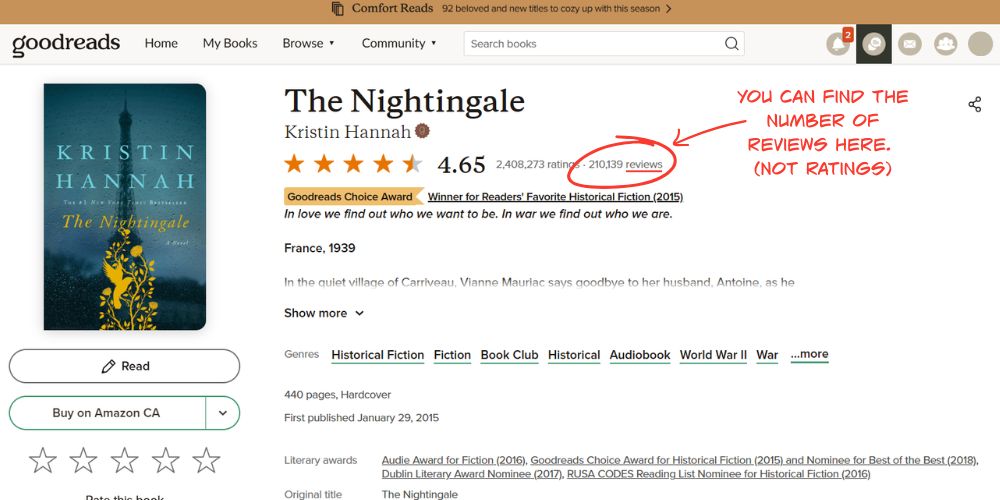
Note that “Goodreads Reviews” are different than simply “Goodreads Ratings.” (Ratings are the number of individuals who have given the book a star rating. The number of Goodreads reviews relates to the written reviews.)
Books with more than 10,000 Goodreads Reviews will be extremely popular books. They may have mostly positive reviews, mostly negative, or a mix of both.
Examples: Atmosphere by Taylor Jenkins Reid, Nightingale by Kristin Hannah, Not Quite Dead Yet by Holly Jackson, Animal Farm by George Orwell, Gone Girl by Gillian Flynn
Goodreads List: More than 10,000 Goodreads reviews
50. A nostalgic read
The Mirriam Webster Dictionary defines nostalgic as “longing for or thinking fondly of a past time or condition.”
For this prompt, choose a book that evokes nostalgia. This may be a personal sense of nostalgia or a book that feels nostalgic for a large portion of readers. Some examples of what this might look like include:
- A book that brings back sentimental feelings from your childhood, as a teenager, college days, a specific season of life, etc.
- Reread a favourite from long ago
- A cover that feels nostalgic
- A new release by an author you loved as a child
- A book in which the characters experience a sense of nostalgia
- A book with themes about intentionally reflecting on the past or yearning for past days
- A memoir in which the author reflects fondly on the past
This will be a highly subjective prompt.
Examples: Charlotte’s Web by E.B. White, Where the Red Fern Grows by Wilson Rawls, The Babysitter’s Club by by Ann M. Martin, Out of Sync by Lance Bass, The Office BFFs: Tales of The Office from Two Best Friends Who Were There by Jenna Fischer and Angela Kinsey
Goodreads List: A nostalgic read
51. Published in 2027
Choose any book published between January 1, 2027 and December 31, 2027.
Note that different regions of the world may have different publications dates for the same book. For this prompt, you may also consider updated or newly released special editions of books previously published. As long as at least one edition is published in 2027, you may read that book using any edition or format.
Examples: Miss Lambert Steps Aboard Danger by Kazuo Ishiguro, A Court of Forgotten Melody by Sarah J. Maas, The Last Days of Vic & Coco by Taylor Jenkins Reid, The Two-Body Problem by Ali Hazelwood, Behind Every Face by Charlie Donlea
Goodreads List: Published in 2027
52. Your final read of the year
Thank you for celebrating 2027 with us! Your final prompt of this challenge is also your final book of the year! (This means that it is the last book you finished in the year.)
This prompt is essentially a freebie. Choose any book, genre, or author that you like. The key is that it’s your final read of the year.
Wanting to finish the challenge early and looking for a creative workaround? You might try a re-read of your final book from a previous year, or your final book in a specific genre.
We know that this prompt won’t be everyone’s favourite. But remember that this challenge is a 52 Books in 52 Weeks challenge; it’s designed to be tackled over the course of a year. Stretch your interpretation if you like, or simply embrace this as a year long adventure. (In fact, this prompt makes for an excellent opportunity to try the “One Prompt a Week” add-on challenge. It will significantly increase the difficulty. You can find the details for that, and a list of other add-on challenges, here.)
Goodreads List: There is no Goodreads list for this prompt.
Happy reading, bookworms!
Your challenge, your rules!